29.620 -
The WB4IUY repeater in Zebulon, NC
BULLETIN! Much new work being done at the
Zebulon site. Click =>HERE<= to see it as it
materializes!
![[bullet]](pinpurpl.gif) 'Good 'ole southern hospitality from the WB4IUY repeater; Wendell, North
Carolina' is heard on the female voice ID of this repeater every 10 minutes when inactive. The voice is
actually that of Debbie Sue, AC4QD. The ID was originally recorded back in 1994, when the repeater
receiver was located about 3 miles to the west of it's current location. The old voice ID
was retained after the move to Zebulon, just for nostalgia. During periods of activity, the CW ID heard on this repeater is 'WB4IUY/r
FM05'. It is sponsored by the Five County Repeater Group and carries the callsign of
WB4IUY, one of it's owners. This repeater is located in Zebulon NC, in a small town
just east of Raleigh NC. This is a split-site repeater; it's receiver and site link transmitter hardware are
located Just north of Zebulon NC, while the transmitter and link receiving equipment are located in
Zebulon `proper`. Both sites are located within grid square FM05. The repeater output is 29.620 mhz, and the input is
29.520 mhz. It has provision for sub-audible tone access on 114.8 hz, but that is not currently in use. It was originally
placed into service on June 20 1994, and operated on 29.680/29.580 for about six months...when it was
moved to the 29.620/29.520 frequency pair currently in use. 'Good 'ole southern hospitality from the WB4IUY repeater; Wendell, North
Carolina' is heard on the female voice ID of this repeater every 10 minutes when inactive. The voice is
actually that of Debbie Sue, AC4QD. The ID was originally recorded back in 1994, when the repeater
receiver was located about 3 miles to the west of it's current location. The old voice ID
was retained after the move to Zebulon, just for nostalgia. During periods of activity, the CW ID heard on this repeater is 'WB4IUY/r
FM05'. It is sponsored by the Five County Repeater Group and carries the callsign of
WB4IUY, one of it's owners. This repeater is located in Zebulon NC, in a small town
just east of Raleigh NC. This is a split-site repeater; it's receiver and site link transmitter hardware are
located Just north of Zebulon NC, while the transmitter and link receiving equipment are located in
Zebulon `proper`. Both sites are located within grid square FM05. The repeater output is 29.620 mhz, and the input is
29.520 mhz. It has provision for sub-audible tone access on 114.8 hz, but that is not currently in use. It was originally
placed into service on June 20 1994, and operated on 29.680/29.580 for about six months...when it was
moved to the 29.620/29.520 frequency pair currently in use.
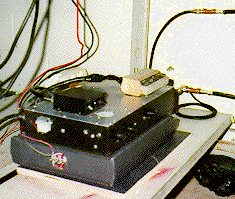
This is largely a 'homebrew' repeater...The first picture on the right is
the repeater receiver and linking hardware. The 10 meter receiver is a converted Hygain CB with a homebrew
I.F. discriminator for FM detection and an ARR bipolar RX preamp. 2 additional stages of ceramic I.F.
passband filters were installed to improve selectivity. A pulse-type I.F. noise blanker was built and installed,
and this was a big help at our sometimes noisy site. Coaxial stubs were cut and installed in the feedline to
eliminate interference from local high-powered 27 mhz operations, and can be seen as the coiled cables in the
far right of the top picture. The discriminator output is amplified about 10 db and fed into a noise switch and
squelch board from a Motorola UHF Micor. I know, as many people have pointed out, it would have
been MUCH simpler to grab a low-band commercial rig and make a simple conversion, but improvization and
building are a part of this hobby that I enjoy.
A homebrew COS is driven from the noise switch and has about -6db
hysteresis. The controller is completely homebrew, as is all audio mixing. The ID'r was built from 2 voice storage
boards pulled from Hallmark Greeting Cards. The ID'r is in a female (XYL
 AC4QD) voice during periods of inactivity, and CW when signals are present on the repeater input. All of the
above mentioned hardware is installed in the black enclosure bolted to the top of the UHF micor (Micor is the
bottom piece in the stack). Note the local volume, local squelch, rptr squelch, and repeat inhibit controls
on the 'front' of the enclosure. There is a local speaker grill drilled into the upper cover just in front of the
RX preamplifier, and an rx S-meter mounted on the side of the enclosure just below the rx preamplifier. That box
is FULL! The controller output is interfaced with a UHF Motorola Micor running about 5 watts output. A pl of
88.5 is encoded on the UHF link tx output during COS activity for linking purposes.
AC4QD) voice during periods of inactivity, and CW when signals are present on the repeater input. All of the
above mentioned hardware is installed in the black enclosure bolted to the top of the UHF micor (Micor is the
bottom piece in the stack). Note the local volume, local squelch, rptr squelch, and repeat inhibit controls
on the 'front' of the enclosure. There is a local speaker grill drilled into the upper cover just in front of the
RX preamplifier, and an rx S-meter mounted on the side of the enclosure just below the rx preamplifier. That box
is FULL! The controller output is interfaced with a UHF Motorola Micor running about 5 watts output. A pl of
88.5 is encoded on the UHF link tx output during COS activity for linking purposes.
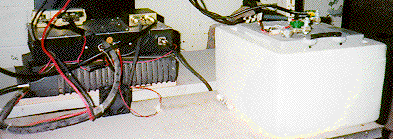
The second photo is a rear view of the 10 meter repeater receive
cluster and linking equipment. A small DC cooling fan is seen as well as the full time battery supply.

The 10 meter receive antenna is a vertically polarized, top-mounted,
Antron 99 omni-directional antenna up about 150 feet. The 10m rx site is linked via 70cm to the tx site at
about 5 watts power through an eleven element UHF yagi at 60 feet. The link and primary 10m antennas are fed
through 75 ohm 1/2" hardline. No matching devices are used, and the match is very good. The uhf-to-hardline
connectors are all homemade from plumbing fittings and have worked flawlessly for years. The homemade
connectors can be seen in the first photo.
This repeater has a full-time 70cm simplex port, as well as
linking capability to the 147.39+ Clayton NC, 147.30+ Wilson NC, and 442.400+ Zebulon NC repeaters. This was
an especially challenging project with MAJOR CB interference, powerline noise, birdies on
10 meters from everything in the county, mega-STRONG signals from amateurs working 10 khz off of the input
frequency on simplex, etc. It all works well now, so all the effort paid off.
This page was broken into two parts to speed loading, so
select the NEXT PAGE of info on the 10 meter repeater (2962a.html) for the
rest of the scoop!
Return to the Repeater Homepage to learn more about
the area repeaters listed and described on the TEARA website!.
Click
HERE to RETURN to the main TEARA Webpage, or click
the floating TEARA watermark on the right!
|